

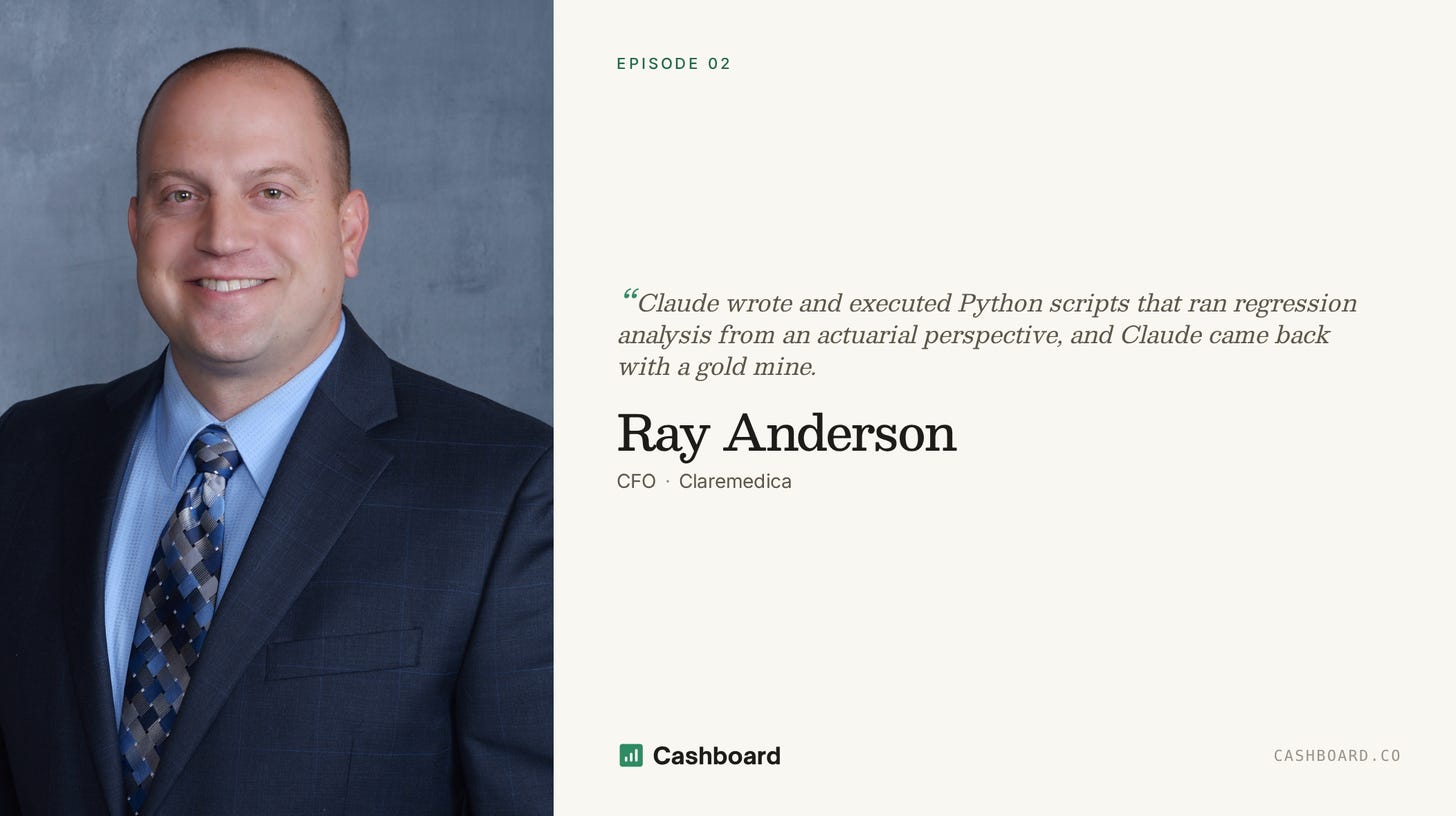
Welcome to Episode 2 of Cashboard’s series of conversations with finance leaders about how they’re using AI in their day-to-day work. This time, we’re excited to welcome Ray Anderson, CFO of Claremedica, a multi-clinic, value-based healthcare operator.
Ray runs finance for a healthcare operator where the data is highly dispersed (lots of systems), high volume (lots of patients), and highly sensitive (lots of PHI). His data lives in Sage Intacct, an internal data warehouse, Power BI, Paycom, and a ton of Excel files. He’s also a Claude power user who has rebuilt how his team runs budget vs. actuals, financial forecasting, and writes SQL.
I’ve known Ray for 1.5 years. He’s smart, blunt, and really tech-savvy. I wanted to interview him because he’s gone deep down the AI rabbit hole, and very candid about what’s worked, what hallucinates, and what he’s had to do to get there.
Please enjoy my interview with Ray about how he’s using AI in Claremedica’s finance function.
If you only read one thing: Ray’s 5 takeaways for finance leaders
Claude is transformative. Pro or Teams gets you access to Claude Cowork and the Claude Excel plug-in, which is where Ray does most of his AI work.
No data scientists needed: Claude is exceptional at writing Python scripts that can run regressions. Ray’s team regressed 2+ years of historical KPI data against past financial outcomes and built a live forecasting model with a tighter standard deviation than anything else they’ve tried.
AI hallucinates most when mapping data fields. A vendor name with an extra space in the wrong spot can break a BvA. And consistency across runs is really hard – something Claude gets right one week might break the next.
Use Claude Projects to control drift across recurring workflows. Ray’s ‘Monthly Variance Analysis’ project carries the output template, guardrails, and last month’s manual fixes from session to session.
Claude’s ability to write SQL enabled Ray to reduce staff time spent on lower-level analytics work.
Thanks for joining us, Ray. Before we get to Claude, what’s the finance stack at Claremedica look like?
Thanks for having me, Julian. In terms of our non-AI stack, Sage Intacct is the GL; we have 7 EMR systems that feed into an internal data warehouse (Microsoft SQL Server); we use Paycom for payroll; and we use Power BI for data visualization.
And I fully live in Excel. I’m a little bit of an old school guy. On any given day, I’ve got six different Excel windows open, doing six different things.
On the AI side, we have a few products that are working really well for us.
Outside of finance, we use an AI copilot for clinicians called Navina, which automates HCC / condition capture from medical records. It takes half a second to accomplish things that used to require a small army of people. It’s really accurate and CMS-compliant. Lots of vaporware out there, but Navina really works. It’s been transformative for the business.
Within finance, we use Claude. We’re on the Teams plan. I mostly use Claude via their Excel plug-in and use their Cowork tool on desktop.
Where did Claude show up in the finance function?
We started by dipping our toes in: here’s a data export from the ledger; here’s a different file that’s our budget; compare the two, and write me an executive summary of a budget-versus-actuals variance analysis. And it did it. It was fast and mostly right.
That said, the horror stories are not unfounded. You can’t just trust it. So rapidly–in concert between finance and data analytics–we started shaping the universe of how Claude thinks. You can give it skills and personas. We’d say, “Hey, you are a healthcare actuary with 25 years of experience, your specialty is X, Y, and Z, take a look at this and give me a CFO-level one-to-two page response.” Once we started narrowing how Claude approaches answering queries, it quickly became much more effective.
Then I started using it like I would use an analyst. Claude is embedded in Excel via their plug-in, and because I live in Excel, I can have six windows open and have it doing six different things. Instead of Teams-ing or Slack-ing a colleague to run something down for me, it’s just operating in the background. The only limiting factor is how quickly I can dictate or type the requests.
Walk me through the KPI and forecasting work. I know you’re doing some really interesting work there.
We always talk about KPIs and leading indicators. We need real-time visibility into how the business is performing. But financials are a lagging indicator, while operating metrics are a leading indicator.
Our holy grail has always been to build a really tight understanding of how today’s operating metrics are likely to hit our financials in the near future.
Claude Cowork helped us achieve that holy grail.
So we pulled operating data from the past 2+ years and fed it into Claude. We said, “Here are the KPIs we track, and here’s the resulting financial picture. We think A correlates with and drives B. Go tell me why that’s wrong.”
Claude wrote and executed Python scripts that ran regression analysis from an actuarial perspective, and Claude came back with a gold mine. We ran this a couple of different times – the first pass back-tested okay, but didn’t correctly track to the future at first, so we ran it through a bunch of cycles. In the end, we came out with a really effective forecasting model.
Obviously, it’s a forecast, and there are unit cost deltas you’re never going to get quite right. But the standard deviation is far narrower than any other way we’ve done it.
What that’s done for the operational leadership team is give them real-time quantitative feedback. We can tell an operator, “Hey, you had a bad day yesterday, what happened? Because this thing spiked and that has an impact of $50,000 or $500,000 or $5,000,000.” It connected the dots in a way that I just don’t think was possible before. And it gives people more confidence that the things we’re measuring are the right things.
How do you actually run a budget vs. actuals through Claude in Excel without it lying to you?
It does hallucinate from time to time. So I’m not trying to portray myself as having perfectly figured this out. Over time, we’ve narrowed the guardrails. There has to be a log of all the changes that you made to the file. The formula list has to be its own tab. There has to be a reconciliation process.
The area where Claude makes the most errors is in data mapping, creating apples-to-apples ties between actuals, budgets, and pro formas. You’ll get a BvA that says you ran $200k favorable on a budget item, but I’ll know that’s not the case. Then I’ll have it go back to the source data and make sure it’s counting everything that has a snippet of a vendor name, and it would be missing one because the name had a space in the wrong spot. So now we save instructions like, anytime you’re looking at a vendor list, do the fuzzy match. Build a checksum. Show me that all the things zero out, the same way we used to when we were building sheets by hand.
I still don’t blindly trust it. But I directionally trust it now.
And how do you control for drift between the March BvA and the April BvA? How do you keep the output structure and the data mappings the same?
That’s a great question, and it’s a real problem if it’s not stored. Claude forgets. You open a new session, and it has no idea what you did before.
For us, that’s where Claude Projects came in. There’s a project called Monthly Variance Analysis. Inside it, we have all the guardrails. This is what the output will look like. Here are the tables to update in the background. Here’s where you go to get this data. Here are the formulas. Here are the things you need to track. And here’s the list of things that had to be manually fixed last time.
It’s a little bit of iteration. I’m sure it’s not the cleanest way to do it. It’s just how we’ve gotten it across the finish line. But it still takes a bunch of babysitting.
You mentioned analytics have benefited a ton as well. How has that changed?
This isn’t really a finance story, but you’ll appreciate it. Claude is really, really good at writing SQL code. This allowed us to reduce the staff time allocated to lower-level analytics. Now, the higher-level folks can just tell Claude what to do, and they get back perfectly written SQL. Their productivity has skyrocketed.
Our senior director said it best: “I can give this task to one of our new hires, and it takes them half a day, then I have to fix it. Or I can type a request to Claude, and I get it back in 32 seconds, and it’s right 99% of the time.”
What about PHI and PII? How do you draw that line?
The constraint we have is that the data must remain within our four walls. The data we’re storing in our database contains PHI and PII, and we don’t have a BII with Anthropic, so we never pull that data into Claude.
So when we’re feeding Claude data, it’s either coming from Sage Intacct as a GL export or from our internal data warehouse, scrubbed or de-identified. If it’s coming from somewhere else, it’s an export already in Excel that we can scrub before it goes in.
That’s the boundary right now. It’s also the question I get from every other healthcare finance person I talk to. Without live data feeds, you can’t put Claude on autopilot.
How do you think about trust in the outputs overall?
I still don’t blindly trust it. But I directionally trust it now.
Finance people are also just not great at making beautiful presentations. We copy and paste the spreadsheet. So you can have Claude interface between Excel and PowerPoint and have it build the deck, or pull the BvA forward into an existing monthly review presentation. That alone takes a lot of work off the team.
The bigger change, though, is that I don’t have to wait for an analyst to come back with a number. I just have to ask the next question.
About Ray & Julian
Ray Anderson is the CFO of Claremedica, a multi-clinic, value-based healthcare operator. He previously held senior leadership roles at Optum, UnitedHealth Group, and GE Capital.
Julian Rowlands is the founder and CEO of Cashboard, the AI enablement platform for FP&A. He was previously CFO of Xendit (last valued at $3bn) and Head of Finance at Spruce (exited to Zillow in 2023). You can learn more about Cashboard at www.cashboard.co.
Interviews with CFOs about AI is an interview series by Cashboard. We speak with finance leaders who use AI in their day-to-day work, and ask them really detailed questions about their setup.
If you’re a finance leader building with AI, we’d love to interview you! Email julian.rowlands@cashboard.co with a quick summary of what you’ve used AI to accomplish, and we’ll get a call booked.
Interesting perspective. The discussion around data mapping, reconciliation, and workflow consistency was particularly valuable. Much of the conversation around AI focuses on capabilities, but this highlights how controls, process design, and data quality remain critical to successful adoption in finance.