


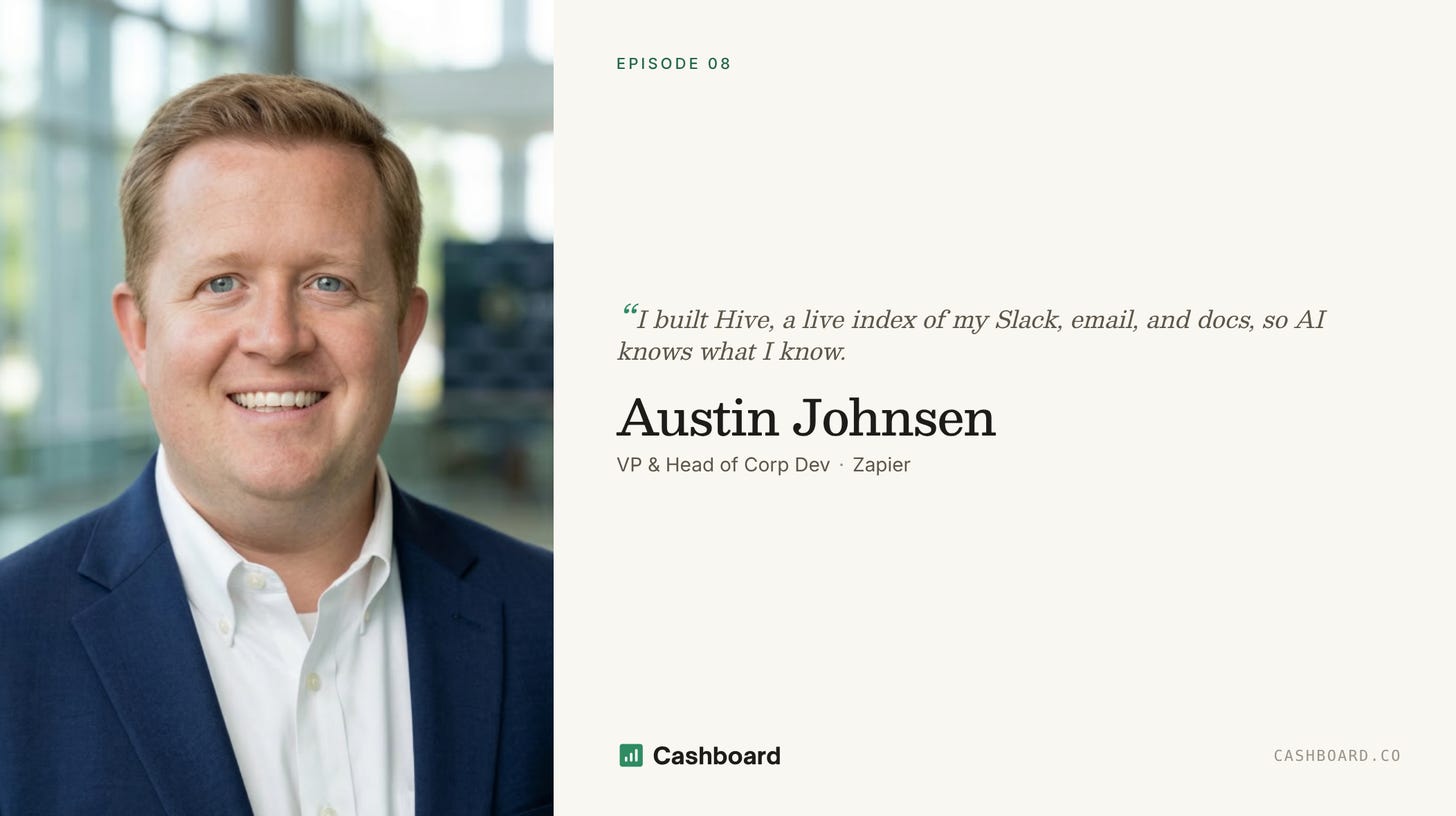
Austin Johnsen is the VP and Head of Corp Dev at Zapier as a team of one. Every time he asked to hire someone, leadership asked him the same question: “Have you run out of things to automate?”
So he kept automating.
He gets a 50-page diligence report on a target in about two hours, for $500 to $1,000 in tokens. A consulting firm would charge him $50,000 to $100,000 and take a month.
He also has his AI agents challenge each other’s diligence findings. OpenAI’s Codex picks apart the first-pass report, pushing the other agents to recheck claims against the source documents. Reading the logs, Austin jokes, Claude and Codex seem to hate each other.
Going in, I expected Austin to have automated the process of buying a company. There’s some of that, but his biggest unlock happens earlier in the process. He built his own live, indexed database of conversations happening across Zapier, and he uses it to figure out where the company has gaps that an acquisition could fill.
Before Zapier, Austin built out the corp dev team at Twitch inside Amazon, and before that he was at Twitter when it bought Periscope. This is our first episode outside FP&A and accounting so it was interesting seeing how sharp Corp Dev leaders are using AI. Moving forward, I’d love to do more of these with other finance functions, like treasury and finance ops. If that’s you — call me!
If you only read one thing: the top 5 highlights from my conversation with Austin
Austin’s biggest unlock is a live context layer he built himself and calls Hive. It indexes a ton of activity happening across Zapier, so he can see where the company has gaps and which acquisitions would fill them.
He makes multiple models argue with each other. Claude drafts, Codex tears the work apart, and when they can’t agree he pulls in more models through Vercel’s AI gateway to reach a consensus.
A diligence report that used to cost $50K–$100K now costs $500–$1,000. It used to be from a consulting firm and took a month but now just needs tokens and takes about two hours. It’s roughly 90% as good.
AI hasn’t made deal cycles any shorter. Legal and negotiation still take four to six weeks. The new problem is that AI makes it too easy to ask the target too many questions.
Nothing goes out without his review. Hard guardrails in code block sending and deleting, every claim has to cite a source, and he still edits heavily (and sometimes rewrites from scratch).
Austin’s stack at a glance
Main interface: Claude Code.
Second opinions: Codex, connected through OpenAI’s command-line tool so Claude can send it work without leaving Claude Code.
More models: Vercel’s AI gateway, which connects to roughly 200 models, including Gemini and DeepSeek.
Connectors: the Zapier SDK. It reaches nearly every tool Zapier connects to, even ones without a native MCP connector.
Context layer: Hive, a self-built local full-text index Austin built with Claude Code. It pulls from Gmail, Google Calendar, Google Drive, Slack, Airtable, Granola, Todoist, Gong, and more.
Deal pipeline: Airtable.
Austin’s path: New Orleans, banking, private equity, Beijing, Twitter, Twitch, Zapier
Julian: Tell me about yourself. How’d you get to where you are now?
Austin: I run corp dev at Zapier and have been here three-plus years, but I’ve been doing corp dev for a long time. I grew up in New Orleans, went to Penn for college, and was at Wharton for undergrad. I went into investment banking, then private equity. The PE fund I worked at was explicitly non-tech. We literally said we would buy any company other than a tech company, but tech was always what I was interested in.
So I went back to business school to switch into tech. I did two years at HBS, then a one-year fellowship in China with the World Wildlife Fund. HBS sponsors you to go work for a nonprofit for a year. WWF was one of the first nonprofits allowed into China, back in the ‘80s, basically because of the panda logo (seriously). Because they were there so early, their offices were technically inside the Forbidden City compound. During lunch I could wander around the Forbidden City by myself.
Then I came out to San Francisco, did another year of banking, and finally got out of banking and jumped to Twitter, where I did finance and then corp dev for about three years. Then I went to Twitch, within Amazon, and built out the corp dev team there over five-plus years. A couple of other stops, including Patreon, and then Zapier. So four or five years of banking and private equity, and corp dev for 10-plus.
Julian: Any acquisitions you want to highlight?
Austin: The one that got me over to Twitch was Periscope. It was Twitter’s live streaming app. In 2015 or so, everyone at South by Southwest was live streaming on Periscope or this other app, Meerkat. This was before you could live stream on Twitter or Instagram or anything else. My boss found it, and we went after it and bought it.
I was one of the first 500 or so users. It was me and a bunch of random celebrities. Through that I learned a lot about live streaming and got to know people at Twitch, which had just been bought by Amazon. People who’d been doing Amazon retail or AWS didn’t know much about game live streaming, and Twitch was thinking about building in-house corp dev. So playing around with Periscope and random celebs is how I ended up spending five years playing games.
Before AI, the job was 20 two-pagers a week
Julian: What was your job like before you started using AI?
Austin: The big thing, in investment banking and corp dev, is how much manual work was involved. When I was a banker, I worked for a guy who had a reputation for working more than the overworked investment bankers. He was very sink or swim. He’d give me work and assume I’d figure it out.
Every company he looked at or wanted to talk to, he wanted what he called a two-pager on it. You had to pull their financials, spread their filings, type in all their revenue numbers, calculate EBITDA, work out ownership percentages. The tools back then weren’t good enough to trust, so I did it all by hand, 10 or 20 a week. Nowadays you’d type a ticker into a service like Capital IQ or FactSet and it would fill out the report.
There are endless manual things like that we used to have to do, and I would never do them now. But I look back and think, I learned how to read filings so fast and get to exactly what I need. Now you don’t get any of that learning.
“Have you run out of things to automate?”
Julian: Tell me about what you’ve built with AI.
Austin: At Zapier, I’m a team of one. Everywhere before Zapier, I had a team, and when I joined I expected to build one out. But Zapier is a no-code automation platform. We connect close to 10,000 tools. If you’re not an engineer and you Google how to connect Google to Salesforce to Excel, Zapier is the top result.
Every time I pitched our CEO or CFO on hiring someone, the response was always, “Have you run out of things to automate?”
So I started thinking about what I’d actually hire someone for. I track my pipeline in Airtable. I’d type in a company name, then go find its website, a description, its fundraising history. It was a giant pain. Half the time it wasn’t done, or I’d wait weeks or months and then do a cleanup pass. That’s exactly the kind of thing you’d give an analyst or associate.
I couldn’t hire anyone, so I automated it with Zapier. These were simple, deterministic zaps from before AI. Here’s a company, go to its Crunchbase page, pull the domain and the fundraising history, because those are always in the same spot.
The one I could never get working was LinkedIn. I also track who I’m meeting with, so if I’m meeting Julian, I want Julian’s LinkedIn in Airtable. But there are enough Julian Rowlands out there that it would never pull the right profile. That was one of the first places I used AI. Once GPT-3 got search, an AI step inside a zap could use context clues, like your company, to find the right profile. I didn’t need to write 50 rules for finding the right person. The AI could figure it out. Mixing deterministic steps with AI steps exploded from there.
Corp dev is too small for anyone to build tools for, so Austin builds his own
Julian: Can you walk me through the lifecycle of a deal and the AI pieces in each stage?
Austin: At this point I have AI everywhere, and it’s expanded a lot over the past year. By the end of last year, using just ChatGPT or Claude chat with the built-in connectors, I was starting to feel like I’d finally run out of things to automate. I was getting ready to tell my CEO, all right, I can’t automate anything else, I need help. Now, with Claude Code, and more and more with Codex, any idea I have, I describe it and ask it to build it.
That matters more in corp dev than in the rest of the finance org. Corp dev is such a small, niche function that there aren’t many tools being built for us. Any time a startup pitches me on building for corp dev, I tell them the TAM’s not big enough. Go find a better space. Finance and accounting have tons of tools. In corp dev, I was always making do. My CRM is really designed for sales, and I’d force it to work for my use cases. Now I can build custom stuff that actually works.
Hive: Austin built a live index of everything happening at Zapier
Austin: Deals start with strategy, with deciding what we should be exploring. One of my biggest challenges has always been staying on top of what everyone in the company is doing. I have one-on-ones with product leads, engineering leads, and go-to-market leads. But Zapier has about 800 people, and priorities are always shifting.
So I built a full context layer. I call it Hive. Claude built it, it runs locally, and it uses the Zapier SDK to connect to every tool I use. It’s constantly ingesting data across Slack, Google Drive, and email. Now I can ask, what’s going on with this project? Have priorities shifted? Who should I go talk to? It’s effectively a thought partner who knows everything going on at Zapier, and it’s been game-changing for strategy and prioritization.
Julian: How did you build it? It sounds like you vibe coded your own app in the middle of all this.
Austin: I’m not an engineer. I sort of pretend to be one with Claude. Claude Code is the pane of glass I operate everything on, but I’ve asked it to build a lot of scaffolding and code underneath that makes it run better.
Hive came out of a laziness problem. I was working on a deal memo, and I kept having to say, what about this? Did you miss this? Look at this too. When I finished, I asked how many follow-up searches it had needed. It was 160 additional calls to other sources. I asked, how do I make it so you know this up front? It said, well, we could build X, Y, and Z. I don’t know what any of that means. So I said, tell me why I’d want this, give me feedback, and if you sell me on it, go.
Julian: So it’s a database on your hard drive with a table for every system that has relevant information. Is it storing summaries, or every Slack message?
Austin: It’s a full-text index now. I was running into problems where it was summarizing things badly. So it’s a 10-gigabyte-plus file that lives locally. I back it up, and I had Claude figure out a way to back up just the index and the vectors, which is only about 500 megabytes, so it syncs properly. If it ever died, it would redownload all the data.
It indexes my work and personal Gmail, Google Calendar, Google Drive, Slack, Airtable, Granola, and Todoist, where I keep my to-do list. I have a little menu bar app that tells me if it’s falling behind. It’s a green button in the corner of my screen that turns orange or red.
It’s indexed most of what I look at, so pulling up my contacts is fast. But it also knows, oh, Austin’s talking to this company and he’s never talked to it before, let’s see if anyone in engineering has played around with it. Then it’ll tell me, Bob in engineering said something about them in a Slack channel you’re not in. Go ping him for his opinion.
If there’s no MCP connector, there’s probably a zap
Austin: Here’s my plug for Zapier. The Zapier SDK is publicly available, and it lets you hit everything Zapier connects to. If there’s not a native connector in Claude Code or Codex, it’s probably connected to Zapier.
So Hive has access to our Gong and basically every tool at Zapier. Before a meeting, I can ask: Is this company a Zapier user? How much do they use it? What do they pay? Has anyone in engineering ever talked to them?
Make the models fight
Julian: Is Hive the only way Claude Code and Codex connect to each other?
Austin: About six months ago, one of our very AI-pilled marketers kept telling me to use ChatGPT more. I kept saying no, Claude’s better, I’m not switching. She said, you don’t have to switch. ChatGPT has a CLI now. Connect it to Claude Code and you can hit ChatGPT directly from inside Claude Code.
That ended up being one of the big unlocks. Every model comes at things slightly differently, and their answers never perfectly overlap. Now Claude gives an answer, and I can ask Codex for a second opinion without leaving Claude Code. Claude sends it to Codex, gets feedback, responds, and they have a whole conversation without me copying and pasting anything.
The even crazier version is Vercel’s AI gateway, which connects to about 200 models. We have around 150 of them approved for use at Zapier. If Claude and Codex can’t resolve something, I’ll tell it to pull in three other frontier models. It’ll come back with, I had Gemini, Muse, and DeepSeek weigh in, and here’s the consensus. It’s crazy expensive, but it gets better answers.
Julian: Better answers are worth money.
Austin: Yeah, diligence is where we spend crazy amounts on tokens. I have a diligence workflow where Claude, running on Fable, does the first pass on a data room. A bunch of subagents give each other feedback and go check the work again. Then Codex comes in, tears their report apart, and sends them back out.
I’m anthropomorphizing a bit, but it’s very funny watching the logs, because Codex and Claude Code seem to hate each other. Codex will say, I can’t believe Claude said that, it’s not supported at all in the documents. Claude will say, what are you talking about, yes it is, look at these docs. Then Codex will say, well, maybe one of those is right, but the others aren’t. They’re being catty and fighting with each other.
One thing I’ve learned is that the models get lazy. If you expect them to hit every file in a folder, they’ll read five and say, I think I got the gist, I don’t need to read the other ten. So Claude wrote code for me that forces it to ingest every single file, write notes as it goes so it doesn’t fill up its context window, and build an index.
Across a very large data room, that takes 90 minutes to two hours. The output is a 50-page diligence report. It costs maybe $500 to $1,000 in tokens. A consulting firm would charge me $50,000 to $100,000 for a similar report and take a month. Maybe theirs is 99% of the way there and mine is 90%. But theirs costs multiples more, and mine takes two hours.
Julian: Are you just ripping through tokens?
Austin: Yes. I spend a crazy amount. I tell our CFO this all the time. The alternative is hiring someone, and that person is going to cost $200,000-plus a year. I spend a lot on tokens, but way less than $200,000 a year.
And in corp dev, I’m looking at acquisitions where we might spend tens or hundreds of millions of dollars. Worrying about $500 in tokens on a $500 million deal doesn’t seem like prioritizing the right thing. It’s a rounding error.
From 30 minutes to 30 seconds on every banker teaser
Julian: I like to ask for hard numbers in these conversations. How much time did a single opportunity take you before AI, and how long does it take now?
Austin: There are two versions. The first is a random inbound. I get a steady stream of anonymized teasers from bankers. I used to spend 20 or 30 minutes on each one, reading the teaser, looking up the company, looking at the website, pulling up information on the people.
I’ve fully turned that into an AI workflow. It reads the teaser, adds the company to the pipeline, and stages a draft email with next steps. So 30 minutes turned into 30 seconds of reviewing the next-step email, and I agree with its next steps about 90% of the time.
One of those workflows is basically a deanonymizer. Before AI, you could sort of figure out who a teaser was about, but it was a pain. Now, if the teaser has enough detail to actually be useful, the AI is going to figure out which company it is. It narrows it down very quickly.
The second version is actual M&A deals, and this is the interesting part. I don’t think AI compresses the timeline. It lets me go deeper and cover more. But diligence increasingly feels like it was never the bottleneck. Negotiations, legal docs, and drafting still take the same amount of time. If a deal took four or six weeks before, it still takes four or six weeks. I’ll mainly blame the lawyers.
The big thing we’ve had to work on is that AI lets us do *too much* diligence. We were asking too many questions about things that don’t move the needle or aren’t material to whether we do the deal. So we’ve put guardrails in place. Do we really need to ask this question? Does it change anything, or are we just creating work for the target because AI makes it easy?
Claude drafts almost everything. Austin sends all of it himself.
Julian: You mentioned writing a deal memo. Are you writing deal memos by hand?
Austin: It’s a mix. More and more, I’m having Claude draft them. But there’s a ridiculous amount of infrastructure around that to make it good. It wouldn’t do well if you dropped some files in a chat and said write me a deal memo.
Through Hive, it has access to every deal memo I’ve written at Zapier, so it has lots of templates and examples. It has everything indexed about the target. And it has a ton of rules on how to write like Austin.
I try to have Claude draft basically everything I send, including emails and Slacks. Then I edit, sometimes very heavily. The system keeps both versions, its draft and mine, tracks the diff, and generates rules about how Austin writes.
Julian: What safeguards do you use? It sounds like there have been times it said it read everything and didn’t.
Austin: Despite all the layers of prompts and code, I’m still asking, did you actually read everything? I know that was your instruction. I still can’t trust the first draft. For deal memos, basically every time, it does a draft, then reviews it to make sure it checked everything. It goes through multiple iterations before I look at it.
I also have two hard guardrails that are code-based. I guess Claude wrote the code, so maybe it could get around them. First, it can only draft. It can never send anything for me. I’ve blocked it from sending emails, Slacks, things like that. I’m sending more and more of its first drafts as is, but there’s enough weirdness in its responses that I don’t know if I’ll ever let it auto-send.
Second, it can’t delete anything. Even if I approve it, it can only move things to the trash. At some point it said, oh, sorry, I deleted that and I can’t get it back. Luckily it wasn’t anything big.
It also has to cite its sources. Whenever it cites numbers, an argument, or something someone else said, it has to link inline or add footnotes so I can go back and check.
Julian: I’m the same way. Sometimes I’ll rewrite something from scratch on my own just to make sure it’s going through my brain. I’ve caught a lot of things that looked really good at the aggregate level, and then when I zoomed in, they didn’t make sense.
What I took away
Single source of truth comes first, even in corp dev.
Corp dev is as much a strategy job as a dealmaking one. You sit inside the business, talk to the CEO a lot, look at internal projects, and keep an eye out for companies that could fill the gaps. To do that well, Austin first had to build his own single source of truth.
A single source of truth is the first step in everything, and Austin’s is just a different one than for FP&A professionals. His goal is to understand the whole company super deeply, including the conversations, the projects, and the really qualitative work. So he saves and indexes conversations happening in a lot of Slack channels, plus his email, calendar, Drive, and meeting notes. It’s bonkers.
Austin can justify $500 in tokens on a single analysis because he’s buying companies for hundreds of millions of dollars. For a single FP&A report, I think that’s probably too much, and I don’t think you should have to spend it. The cost comes from pulling in so much unstructured data from so many different places. You also don’t need what Austin built for something like budgeting. Budgeting is collaborative, and other people have to submit their projections, like who they’re going to hire next year.
You don’t have to wait on a missing MCP.
Right now everyone is in a kind of arms race to connect their systems to AI, and everyone has that one system that doesn’t give you good data over MCP (Model Context Protocol, the standard way AI tools plug into other software). Some accounting systems have good MCPs you can pull transaction data from. Others don’t.
Austin’s point was that you’re not stuck. Through the Zapier SDK, he pulls from tools that don’t have a native connector at all. I need to dig into this more for finance systems, but you don’t need to wait for a vendor to fix its MCP before you can get at that one other system. Quickbooks, for instance, doesn’t allow you to pull transaction level data via their MCP. Maybe you could get around that with the Zapier SDK.
The smartest people are still doing their own thinking.
Austin is the first non-engineer I’ve talked to who’s running multiple AI platforms at the same time, and he still doesn’t let any of them send anything.
That’s further validation of something I keep seeing. The smartest people I know are still running their checks. They’re not letting AI just send stuff or write stuff. They review everything, and they often rewrite it by hand. The people I come away from these calls respecting the most are not abdicating their thinking to the machines.
About Austin & Julian
Austin Johnsen is the VP and Head of Corp Dev at Zapier. He previously built the corp dev team at Twitch (Amazon) and worked in finance and corp dev at Twitter, where he helped acquire Periscope.
Julian Rowlands is the founder and CEO of Cashboard, the AI FP&A platform. He was previously CFO of Xendit (last valued at $3bn) and Head of Finance at Spruce (exited to Zillow in 2023). You can learn more about Cashboard at www.cashboard.co.
Interviews with CFOs about AI is an interview series by Cashboard. We speak with finance leaders who use AI in their day-to-day work, and ask them really detailed questions about their setup.
If you’re a finance leader building with AI, we’d love to interview you! Email julian.rowlands@cashboard.co with a quick summary of what you’ve used AI to accomplish, and we’ll get a call booked.