

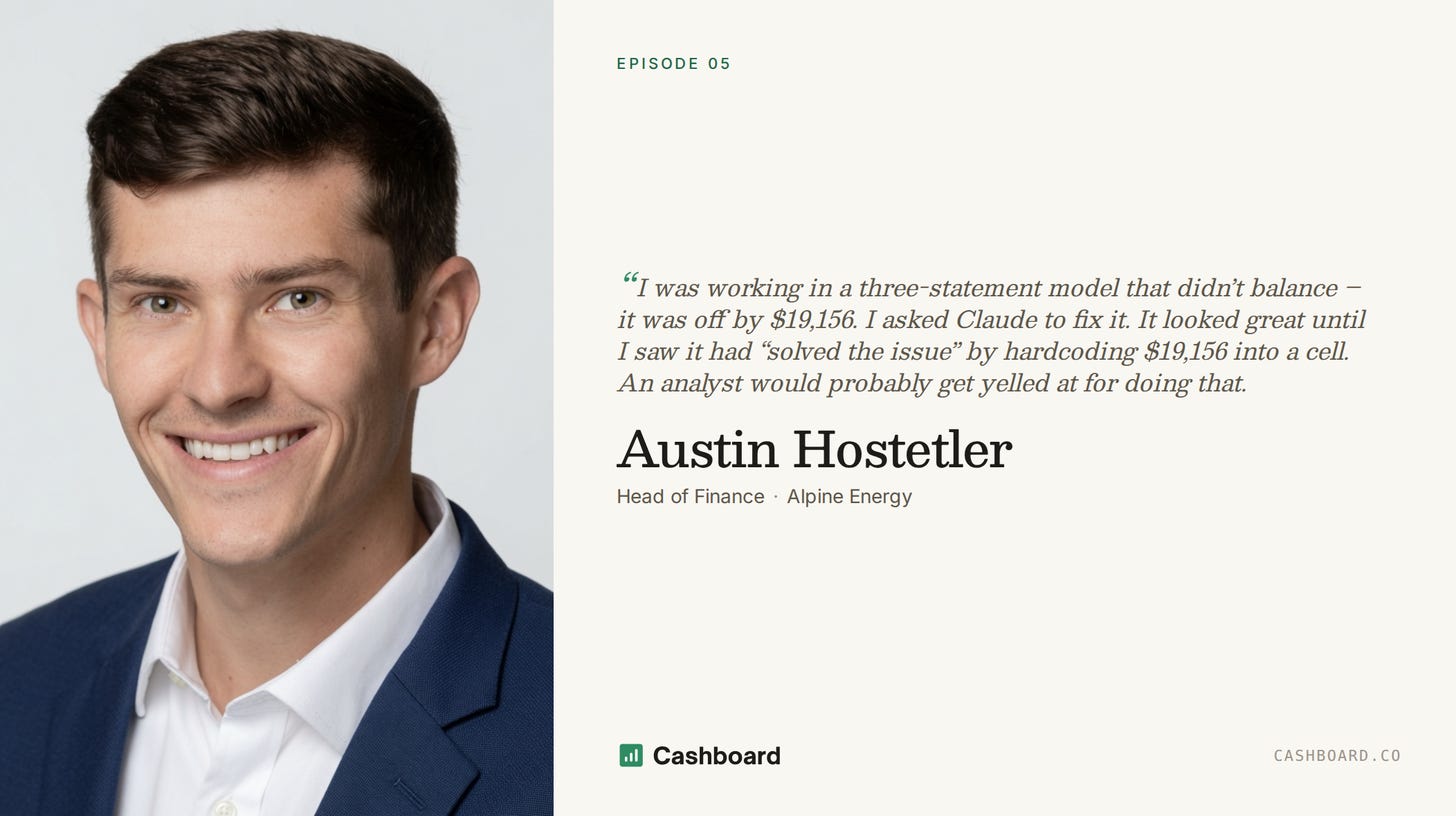
Austin Hostetler recently used Claude to turn a Nordic bond term sheet into a working compliance model in about 15 minutes.
Then he used it to review the financial model going to Alpine Energy Services’ investment bankers and predict the questions they were likely to ask.
Austin is the Head of Finance at Alpine, a fast-growing hydraulic fracturing company that recently doubled in size, is preparing for additional fleet growth, and is now reporting to public bond investors.
The finance team is lean. Reporting and compliance requirements are not.
Austin has equipment leases, a Nordic bond with its own covenants and reporting requirements, a growing accounting operation, and an Excel model that needs to keep up with it all.
So he has started using Claude as a finance associate who remembers every loan document, reviews every model, and never gets tired of being asked a dumb question.
Usually, it works extremely well.
But once, Austin asked Claude to fix a three-statement model that was out of balance by $19,156. Claude solved it… by hardcoding $19,156 into the cell in question.
(My joke to Austin: wow, that’s the AGI moment. Every human CFO has done that too!)
And that’s the tension at the center of Austin’s AI setup: Claude can do in minutes what used to take a finance team hours, but only if someone who actually understands the work is watching the outputs.
With that, let’s dive in!
If you only read one thing: the top 5 highlights from my conversation with Austin
A Claude Project can become the institutional memory for your debt documents. Austin loaded Alpine’s bond documents and equipment lease schedules into one Project. He can now ask about covenants, interest dates, reporting requirements, or individual lease terms without searching through hundreds of pages.
Claude built Alpine’s debt compliance-reporting model in about 15 minutes. Austin gave the Excel plug-in the bond term sheet, sample reports, and access to Alpine’s financial model. It created a quarterly reporting tab with leverage, liquidity, and covenant-headroom calculations. Austin estimates the first draft would have taken him hours.
AI is especially useful before high-stakes finance meetings. Before sending forecasts and financials to Alpine’s investment bankers, board members, and executive team, Austin had Claude review the model for errors and generate the questions that were likely to be asked. This helped Austin quickly run scenarios that drove Alpine’s decision-making around capital structure, capex decisions, and fleet timing.
The QuickBooks connector is turning Claude into an accounting operator. Alpine is testing workflows where Claude reads billing spreadsheets, creates customers, builds invoices with multiple line items, and prepares month-end journal entries. Humans still approve every action before anything is written.
Never trust a Claude-authored financial model just because it balances. When Austin asked Claude to fix a $19,156 difference between cash on the balance sheet and cash on the cash flow statement, Claude solved it by hardcoding in $19,156. The output looked perfect, but the logic was broken.
Running finance for a company that keeps adding fleets
Julian: Before we get into AI, give us some context on Alpine Energy and what the finance function is dealing with right now.
Austin: Alpine is growing quickly. We launched another fracking fleet recently, and we are already looking at multiple opportunities to build more. At least one of those could happen by January 1.
Each fleet means more equipment, more financing, more employees, more operational data, and more reporting.
We also recently completed a Nordic bond offering, so now we have quarterly reporting requirements, compliance certificates, interest-payment dates, and covenants that we need to stay on top of.
We are still running a lean finance and accounting team. I am hiring a finance associate now, and we will probably add accounting headcount as we grow. But the goal is to use technology to keep the team as efficient as possible.
Julian: You used Claude to help create the test for the new finance associate, right?
Austin: Yeah. Someone can tell you they are good at three-statement modeling, but you are taking their word for it.
Claude helped me create two tests. One is a simple LBO model. The other is a three-statement accounting model with intentional errors that the candidate needs to find.
We are also asking the candidate to screen-record the test so we can see how they work through it. But they aren’t allowed to use AI to solve it – I need proof that they understand financial modeling completely.
Alpine’s finance and data stack
Julian: What does Alpine’s finance tech stack look like?
Austin: QuickBooks Enterprise is our accounting system. Paycom is payroll. We use Cashboard for FP&A, analytics, reporting, and fleet-level financials.
I’m very involved in our three-statement model, forecasting, budgeting, and financing scenarios.
We recently moved our corporate cards and expense management to Ramp, which has been a huge upgrade from what we were using before.
Operationally, a lot of our field data lives in FieldPro. That includes pumping hours, inventory, consumables, maintenance data, and other KPIs.
We also track job updates in Slack. Each fleet has stage-by-stage updates, including maintenance issues and operating activity.
On the AI side, Claude is our main tool. It started with a couple of other people and me, and now we are trying to spread it across more of the company.
The finance associate who remembers every loan document
Julian: What was the first big win that you got from Claude?
Austin: Debt compliance. We have several equipment lease schedules with lenders. Each one has different terms, payment amounts, and reporting dates. Then we have the Nordic bond documents, which contain the covenants and reporting requirements for the bond.
Without Claude, it would take me so much time to create and deliver all the required reporting.
But Claude solved all of that. First, I put all of those documents into a Claude Project. Now it is almost like having a finance associate or legal person who remembers every word of every financing document we have.
I can ask when an interest payment is due, what reporting we need to provide, how a covenant is calculated, or what the terms are on a specific lease. I do not need to open five PDFs and start hitting Control-F. I also had it build a calendar with all the important dates across the documents.
Julian: I love using Claude to find things that are buried in a document. AI isn’t wise, but it’s amazing at ingesting information.
Austin: Exactly. You still need to verify important things, but it gets you to the right section much faster. It is also helpful because you can ask the dumb question you might be hesitant to ask someone else. That applies more broadly to AI. You can advance faster because you have somewhere to ask basic accounting, finance, legal, or modeling questions without worrying about looking stupid.
Building a quarterly compliance report in 15 minutes
Julian: You also used Claude to build the actual bond-reporting template.
Austin: I use the Claude plug-in inside Excel. My financial model has all of our historical financials, forecasts, and dozens of supporting tabs.
I dropped the bond term sheet into the Claude sidebar. I also gave it a few examples of quarterly reports from other companies that had completed similar offerings. Then I told it to use the reporting requirements and covenants in the term sheet to build a separate quarterly-reporting tab inside my model.
It created the structure, the net leverage calculation, the liquidity calculation, and the compliance lines. It also highlighted how much cushion we had against each covenant. That is now part of my rolling financial model.
It probably would have taken me hours to create the first version. Claude did it in about 15 minutes. I had to make some tweaks, but it got me most of the way there.
Julian: And now the reporting model updates live as actuals get updated?
Austin: Exactly. As the historicals and forecasts change, the bond-reporting tab updates. I have similar reporting tabs for the equipment leases. You still need to understand how the calculations work. I would never rely on it without checking the logic. But instead of giving an analyst a day to build the first draft, it just creates the first draft.
Reviewing the model before the bankers do
Julian: How else did you use Claude during the bond process?
Austin: I was constantly updating our financial model and sending it to the investment bankers.
Before I sent anything, I would have Claude review the entire model for errors and issues. I would also ask it to quiz me: Based on this forecast, what questions will the investment bank or potential investors ask?
That was useful because it prepared me for the conversation. It would flag a change in margins, a working-capital assumption, a capital-expenditure number, or something else an investor might question. It was checking the model and also helping me prepare to explain it.
Julian: I feel like Claude’s output is a little hypnotizing. The formatting looks perfect, everything looks clean, and your brain wants to conclude that it must be correct. But that stresses me out – for something going to investors or the board, I still need to understand and stand behind every number, and not being the person who wrote every formula feels scary.
Austin: I agree. It is a first-pass analyst and a reviewer. It can’t be the person signing the compliance certificate.
Letting Claude operate QuickBooks
Julian: What are you doing on the accounting side?
Austin: We are starting to use the QuickBooks connector directly through Claude.
There is a lot of accounting work that can be administrative. You need to create a customer, set up an invoice, add the line items, assign the right GL accounts, or prepare a journal entry from a spreadsheet. Those tasks are necessary, but they can take the accounting team hours.
We have invoices with a lot of line items. Our accounting team can give Claude the spreadsheet containing what needs to be billed. Claude can then prepare the customer and invoice inside QuickBooks.
The important part is that it asks for approval. Before it creates the customer, you review it. Before it creates the invoice, you review the line items and GL accounts. Then you approve the action. Something that might have taken a couple of hours can happen in seconds.
The same concept applies to month-end journal entries. Our team may have an Excel file with the backup for payroll entries, credit-card entries, or other recurring journal entries. They can give that file to Claude, have it prepare the entries in QuickBooks, review them, and then approve them.
To me, this is not optional. We need to automate more of this work. Remove the tedious administrative work so the accountants can close faster and focus on more important things.
The $19,156 solution
Julian: Where have you seen Claude go off the rails?
Austin: I had one example that was pretty funny.
I was working in a three-statement model. The model didn’t balance – it was off by $19,156. I asked Claude to fix it. It whirred away and then fixed it. Boom – everything tied perfectly.
It looked great until I clicked around and saw that Claude had “solved the issue” by hardcoding $19,156 into a cell. An analyst would probably get yelled at for doing that.
Julian: [Laughing] Who amongst us hasn’t hardcoded a cell to make your 3-statement model balance?
The disappointing part is that Claude only hard-coded one cell. A truly CFO-trained AI tool would hard-code the whole model before sending!
Austin: Right. That is when you know it has reached true CFO-level intelligence.
But it is a good example of why you need to understand the fundamentals.
If you do not know how a three-statement model is supposed to work, you might see that everything balances and assume it fixed the problem. It didn’t fix the problem… it hid it!
An assistant that knows everything about the company
Julian: So what’s the holy grail? What do you ultimately want AI doing for Alpine’s finance team?
Austin: There are probably three things.
The first is automating processes. As the company grows, we will add people, but I do not want to add staff accountants and analysts at the same rate as revenue and fleet growth. AI should take over more repetitive work so the finance and accounting teams can focus on higher-value things.
The second is speed. We are talking with lenders, expanding the bond, putting working-capital facilities in place, adding equipment leases, and modeling fleet growth. There are constantly new scenarios. Should we buy or rent a piece of equipment? What does the capital structure look like? What happens if the next fleet starts in October instead of January? We need to produce and update those analyses quickly.
The third thing is having an assistant that knows everything about the company. During our weekly cash flow meeting, I might want to know the receivable balance for a specific customer or how many days it's outstanding. Today, I may need to open QuickBooks, find the right report, click into the customer, and look it up. I want to ask Claude and get the answer in two seconds.
Julian: So not just the income statement. It needs the general ledger, balance sheet, historical models, operational data, debt documents, and all the context around how Alpine measures the business.
Austin: Exactly.
The operational data matters too. We track fleet-level financials in Cashboard. Once that data is connected to Claude, I want to ask: How much did we spend on fluid ends for Bravo Crew this month? Or show me the trend in maintenance spending by fleet. Or tell me what happened operationally on Alpha Crew yesterday based on the Slack updates.
That is where it gets really powerful. It is not just searching one system. It knows how the whole company fits together.
Julian: There are two sides to that workflow. You can use AI to write information into the systems faster: create invoices, record journal entries, reconcile transactions.
Then you can use AI to read the information back out: answer the AR question, explain the spending change, summarize fleet economics, automate the write, automate the read, and reduce the human job to review.
Austin: That is exactly it.
About Austin and Julian
Austin Hostetler is the Vice President and Head of Finance at Alpine Energy, where he oversees finance as the company expands its fleet operations and financing programs.
Julian Rowlands is the founder and CEO of Cashboard, the AI FP&A platform. He was previously CFO of Xendit, last valued at $3 billion, and Head of Finance at Spruce, which was acquired by Zillow in 2023. You can learn more about Cashboard at www.cashboard.co.
Interviews with CFOs about AI is an interview series by Cashboard. We speak with finance leaders who use AI in their day-to-day work and ask them really detailed questions about their setup.
If you are a finance leader building with AI, we would love to interview you. Email julian.rowlands@cashboard.co with a quick summary of what you have used AI to accomplish, and we’ll get a call booked.