


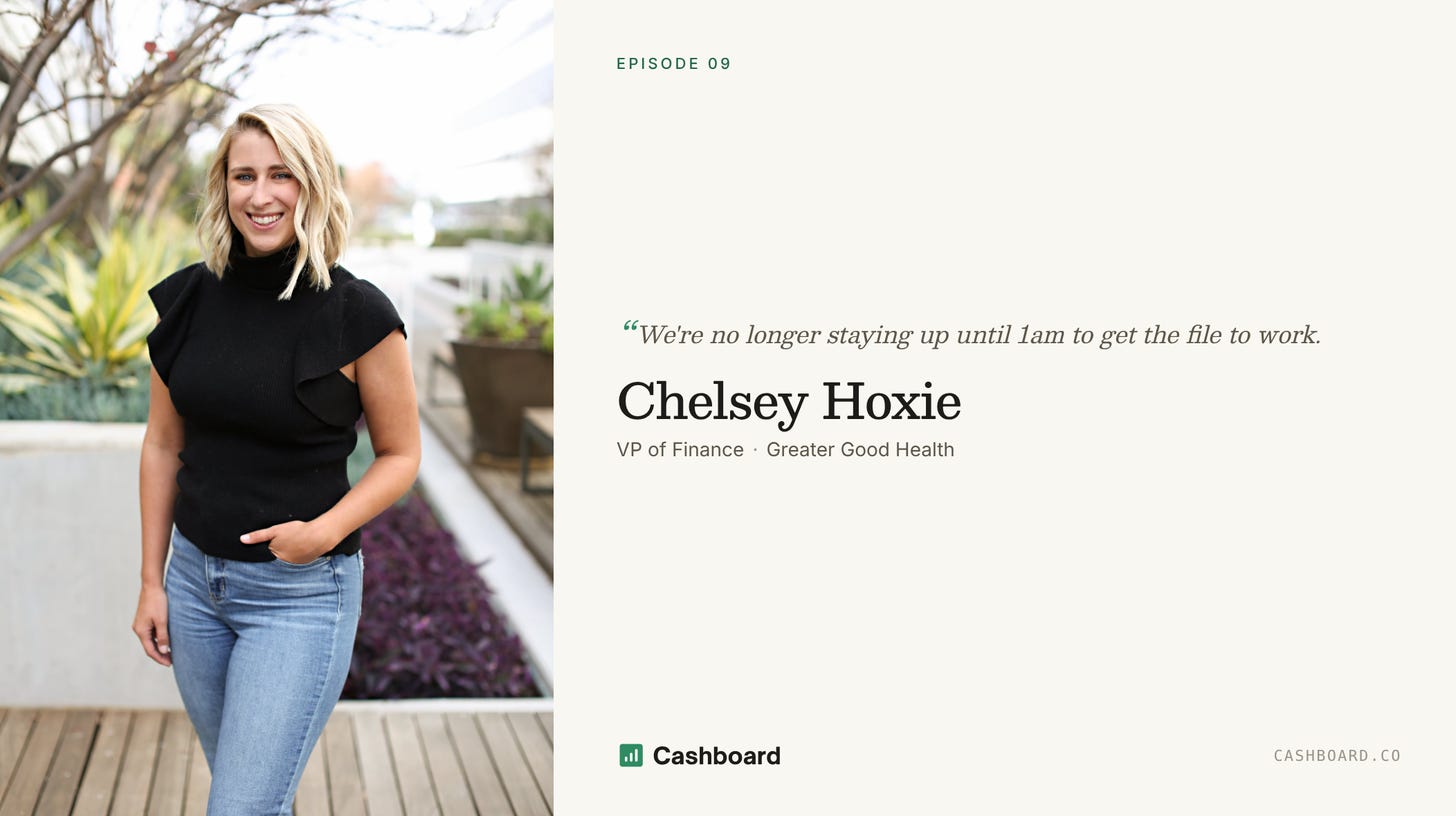
Chelsey Hoxie’s finance team used to spend three or four days building a 30-tab reporting package each month. Now Claude builds it in under an hour. They’ve also cut two days off of close: booking a month of revenue for their primary care clinics went from 12 hours to about 1, and the payroll journal entry went from 4 hours to 5 minutes.
Chelsey is VP of Finance at Greater Good Health, a fast-growing, multi-state value-based healthcare company. She joined as employee number 17. The company is now approaching 250 people, and she oversees accounting, FP&A, revenue cycle, and payroll.
Over the last six months, her team has put a lot of the finance function into Claude skills. Contract review, lease schedules, and payroll reconciliations all run through skills, and they all have a tab of audit checks that flag numbers that don’t tie.
Then they decided to attack the budgeting process. I talk to a lot of finance leaders who are automating reporting, but Chelsey is one of only a few people I’ve heard of using Claude for their actual planning process.
Her budget owners now type what they need in plain English, and a Claude skill puts it into finance’s format. The master budget recalculates with every submission. Every cut is logged against what the owner originally submitted. The full budgeting cycle takes about as many weeks as it used to, but the 1am nights spent manually merging templates are gone.
When I was a CFO, the thing that I hated most about budgeting was document management: sending templates to every budget owner, asking them for revisions a couple of times, and merging it all into one master file. That’s why budgeting always took three tedious months.
Chelsey’s team has done really good work to solve a lot of those pains. It’s the clearest example I’ve seen of a data-savvy finance team using Claude to take loops out of budgeting and make it a lot less painful. But candidly it felt like an incremental improvement, at least compared to reporting (which is almost entirely automated).
This also required a very specific finance team: lean, with data backgrounds, and supporting AI-savvy budget owners. It took Chelsey’s team a lot of savvy and upfront thought to build the Claude skills and projects that make certain steps go faster.
I also don’t know if this process can scale to a company with >500 employees. I’ve heard of bigger companies that are trying to run all their budgeting in Claude. They’ve told me they now spend most of their time auditing because they can never trace back what’s included in the budget or forecast. Chelsey’s team have built audit trails into their processes, but I’m still nervous about AI authoring the changelog in a spreadsheet instead of having a battle-tested audit trail in deterministic software. Hallucinations still exist, and the risk increases the bigger your spreadsheet is.
So, I’m not positive this is right for everyone. But it’s definitely right for Chelsey and Greater Good Health!
I loved getting to learn about the reporting and close skills that came first and the 20+ audit checks behind every one of them. Then we got into the budget build itself, from the templates budget owners fill out to the skill that recalculates the master file and logs every cut. We also talked about what she’d still want from a planning tool, and where she thinks a Claude-only setup starts to break down.
Let’s dive in!
If you only read one thing: the top 5 highlights from my conversation with Chelsey
The setup and pre-work were the big lifts. Before budget season, Chelsey’s team built three skills in a shared Claude project. One generates every budget owner’s template. Another adds each submission to the master file and calculates finance’s formulas. A third helps budget owners fill out their templates. Those upfront investments are what paid off for Chelsey and her team.
Budget owners stayed in Excel, but Claude helped them fill out their templates. Finance set up the templates so budget owners only had to submit the drivers and core units of their business, like each new hire. Finance owned the overhead, like payroll tax and benefits. Budget owners used the Claude plugin, and specifically the budget owner skill, to turn what they typed in free text into the data structure finance needed.
She still thinks an AI planning tool could be a better experience. She’d consider one if it had an AI chat that budget owners could use to make changes and run scenarios quickly. Today the team still merges submissions by asking Claude to do it. Claude does a good job, but nothing happens automatically, so someone on the finance team has to tell Claude to run each step.
AI can make really stupid work look really pretty. That’s Chelsey’s line. Her answer is 20+ audit checks in every skill and an audit check tab on every output. If a check fails, the skill stops and asks before it produces anything.
AI helped save a ton of time on reporting, while budgeting took just as many weeks but got a lot easier. The 30-tab reporting package went from three or four days to under an hour. The budget cycle took about as long as it used to, but it stopped eating up late nights, and the team spent more of its time on conversations and strategy instead of pure execution in Excel.
Chelsey’s stack at a glance
AI: Claude, on a HIPAA-compliant instance with a BAA (business associate agreement) in place. The team uses a lot of shared Projects and spends time thoughtfully building their own Skills.
Accounting: Multiple instances of QuickBooks.
Payroll: Multiple instances of Paycor.
Spreadsheets: Excel.
Close checklist: monday.com.
Data access: manual exports dropped into Claude projects each month, because the Quickbooks MCP doesn’t expose transaction-level data to Claude.
Chelsey’s path: North Pole, Alaska, Children’s Hospital Los Angeles, Greater Good Health
Julian: I always start by asking people about themselves. What brought you to being VP of Finance at Greater Good Health?
Chelsey: I started my career in pediatric healthcare. I worked at Children’s Hospital Los Angeles for about five or six years. I popped around a few different spaces there, but they were all either analytics-driven or finance-driven. I was an analyst in a couple of departments, I managed budgets, prepared revenue cycle analytics, and helped our controller.
In my last two years there, I moved into operations. I had all this knowledge of what the data was showing, and I wanted to use data to change the front-end workflows and manage people with data-driven processes. I did that through COVID, which was a really interesting time to be in healthcare operations. I led the front-end, non-clinical staff across our clinics and our COVID vaccine and testing site: scheduling, referral intake, financial authorizations.
Then a friend I’d worked with for a while called and said I had to come over to Greater Good Health. There were brilliant people doing really cool things, and they wanted more athletes who could lean in and help build the company. I was the 17th or 18th employee, so it was a little crazy to join, but it’s looking good now. We’re projected to hit about 250 FTEs pretty soon.
I was brought over, really vaguely, to build a finance department and an analytics department. We went from outsourcing a lot of that to bringing accounting expertise in-house. Today I oversee accounting, all of FP&A, and revenue cycle, so the claims lifecycle on the healthcare side, plus payroll, state expansion, and some of the fringe departments.
Julian: I’m going to lead the witness on one thing. Where are you from?
Chelsey: North Pole, Alaska, which is always a fun one. It’s about 3,000 or 4,000 people in the city limits. And because it’s North Pole, it’s Christmas all year round. Our streetlights are candy canes, the holiday decorations stay up year round, and there’s a reindeer farm behind the Santa Claus House. For the last 15 years or so, I’ve been avoiding winter. I lived in South Carolina, then Los Angeles for about 10 years, and I’ve been in Phoenix for the past four or five.
Julian: Did running healthcare operations through COVID shape how you work now?
Chelsey: It led directly into the startup world. You had to get scrappy and creative and pivot quickly. You were doing things for the first time and seeing data for the first time, and you didn’t have the luxury of time to build things out and test them. You needed to be able to say: Is this working? No? Okay, let’s switch it quickly. Rolling out telehealth across the hospital for the first time was a massive undertaking that required a lot of flexibility.
Seven skills now build a 30-tab reporting package in just 1 hour
Julian: Let’s start high level. What does your finance team use AI for?
Chelsey: We’ve done quite a bit just in the last six months. Getting access to a HIPAA-compliant Claude platform was key, because it meant we could actually put our data in there with a BAA in place. It took a while to get it to a place where we could roll it out to the whole team.
The first big one was our financial reporting package. It feeds our internal report-outs and our investor reporting, and it’s now completely automated with about seven Claude skills.
Julian: How does Claude get the source data? You have a bunch of different QuickBooks instances, and last I checked, the QuickBooks MCP (Model Context Protocol, the standard way AI tools pull data from other software) doesn’t give you transaction-level data.
Chelsey: It’s a manual drop. The P&L and the balance sheet both have a detail view. It’s an ugly format if you want it in Excel, but Claude handles that format perfectly. So I export the P&L detail and the balance sheet detail and drop them into the project. All our P&Ls, balance sheets, and payroll journals go into one project, and that feeds seven to ten different skills the team uses for financial reporting and journal entries. Anyone in the project can run workflows off of it.
Long term, I’d like some kind of direct connection that pulls the data automatically, whether that’s through a warehouse or something else. Right now we’re focused on making sure the output is correct.
Julian: I always like to ask for hard numbers. How long did reporting take before, and how long does it take now?
Chelsey: That was a huge win. It used to take us about three or four days. We’re a pretty data-savvy team, so it was already a fairly automated Excel file: paste data into a tab, everything updates, shift some columns over. But there were so many tabs and so many “drag this, update this” steps that it got really tedious, and it was easy to forget something. Then we’d be rushing to figure out what the data was showing and what we should recommend.
Now it’s generated in less than an hour, including pulling all the reports. We spend those days analyzing it instead. Why do we have highs and lows here? What can we do about it? It’s been a really nice shift toward using our time better.
AI can make really stupid work look really pretty
Julian: So the reporting skills draft everything, and then somebody reviews it?
Chelsey: Yes, and we require audit checks in everything. We’re very mindful that these things go directly into our financials. Every skill we’ve built has a set of 20+ audit checks. If A plus B always needs to equal C, it makes sure A plus B equals C across the entire document. Our financial package is 30+ tabs in Excel, and there’s an entire tab of just audit checks. If a check fails, it stops the program from running and asks you what to do. Nothing gets produced unless the audit checks pass.
Anytime we produce something in finance with Claude that’s going into one of our financial systems or an investor report-out, an audit check tab is required.
Julian: The classic mistake I made building reporting before AI was that everything would tie out, I’d send it, and then I’d realize I forgot to update something from last month’s report. How do you keep reports connected to each other?
Chelsey: Right now it’s our control process. We still have a pretty small team touching things. If someone adjusts a prior period, there’s a checklist: this person reruns this skill, that person reruns that one, and I reapprove everything. We track our close work list in monday.com.
Julian: So many times Claude has built something for me that looked awesome, and then I double-check a formula at the last minute and it’s hardcoded. How do you guard against that?
Chelsey: I’ve been saying a lot lately that AI can make really stupid work look really pretty. You have to be really careful not to let that go out. Driving specific audit checks is how we’ve solved a lot of that.
The lease schedule that looked right and was wrong
Julian: Any errors that have popped up, or things you’ve caught before they went out?
Chelsey: One example of where that did come up is lease schedules. We used Claude to generate all of them. Lease accounting is tedious, and we don’t want to hire a bunch of technical lease accountants. We have a handful of leases, and they’re pretty straightforward.
The first lease it spit out looked really correct. Then my accountant audited it, and we found it was using some of the assumptions incorrectly and building the lease wrong.
So we changed the process. We already had lease schedules that had been fully vetted and audited by our technical accounting firm. We fed those into Claude first. Instead of saying “spit out this lease schedule,” we said, “generate a skill that builds a lease based on all of these assumptions, and this is what the output should look like.” Get the foundation right first. Then we fed it the new lease and said, “Now go build this one.” It did everything correctly the second time around.
Julian: In AI engineering, that’s called a golden dataset. It’s a known best practice to give AI a human-authored A+ example and ask it to replicate that, instead of asking it to build from scratch. It’s also part of how AI models get trained. It’s why companies like Mercor make so much money having human experts write materials that get fed into models as training data.
Close is two days shorter, and there’s more to cut
Julian: What time savings did AI get you on close?
Chelsey: Our primary care revenue took about 12 hours from start to finish. Now it takes about an hour, including the audit and review. Our other big win was payroll. That journal entry took maybe four hours to finalize, audit, and reconcile. Now it takes about five minutes, with no errors so far, because we ran them side by side. Between those two, we’ve shaved a good two days off our close. We think there’s still opportunity to shave off a few more as we build more reconciliations and journal entry workflows into Claude.
We also built a payroll reconciliation from our payroll system into QuickBooks, plus skills that take that data and spit out a QuickBooks import file. There are a handful of reconciliation and journal entry skills like that.
And there are other wins outside of close. We also built a skill for contract review. We told Claude all the best practices and the things we look for: terms that are unfavorable to us in a vendor contract, language we want written a certain way. Putting our thinking into a skill means more than one person can drive contract review. We still have controls and sign-offs from the finance team to make sure it caught everything.
We’ve also moved all our policies and procedures into Claude and run audit checks across them. If I make a new policy or tweak one thing, it tells me which other policies I need to update or which ones are now inconsistent. It’s cleanup work that lets us do more without reviewing every single document.
Budgeting moved to Claude because Excel kept crashing
Julian: So you did all this, it was working really well, and you thought, let’s try it for budgeting?
Chelsey: The problem was that we were still in Excel. We hadn’t purchased a planning tool, and last year Excel was crashing constantly. Our budget file is massive. It has all our financial calculations, tons of SUMPRODUCTs, lots of formulas. If you added a line or a column or edited something and it tried to recalculate everything, it crashed. So we were doing a lot of rework. The company has gotten a lot bigger than when we started in Excel, and recalculating that many formulas across that many rows was causing delays.
It also meant we couldn’t be quick about analysis. We couldn’t just ask, “What if we approved this? What’s the impact on the entire budget?” It would be: okay, let’s spend a couple of hours figuring out the impact, and then undo it if we don’t approve it.
When the financial reporting started running really smoothly via skills, and the computing was way quicker and way more accurate, we decided to try using Claude for our budget process too.
Budget owners focus on strategy. Finance owns every formula.
Julian: Walk me through how the whole thing works.
Chelsey: The first thing was really simple: we used Claude to help design the program. We took last year’s kickoff deck, added a bunch of assumptions, and asked it to build this year’s. We also gave it everyone we needed to schedule, our priorities, and our time period, and asked it to create the workshop schedule. When is everything due? When are we meeting with everyone? That was more like executive assistant support, plus communicating the expectations and timelines to all our budget owners so everyone was aligned.
The next piece was template engineering. Every lane owner, meaning each cost center or budget owner, gets an Excel template in the exact same format, with formulas pre-populated so no one has to touch them. Here’s what the files look like:
Tab 1 is instructions.
Tab 2 is the template we require for FTE justifications.
Tab 3 is the three year roadmap tab, which asks: What do you think is going to break in two years if we double our revenue or our FTEs? It’s more memo-style and looks past the 12-month budget period.
Tab 4 is the expense tab, which has all our GLs pre-built with dropdowns, plus labels for the levers and ratios we require. Everything submitted needs a lever or ratio: what would cause us to double this FTE, or increase this subscription cost?
We tell budget owners to keep their submissions bare bones. Don’t add your existing FTEs. Don’t worry about payroll tax, 401(k), reimbursements, health benefits, or anything that’s a formula. We don’t want budget owners spending time figuring out the payroll tax percentage. We own that on the finance side. We say: use your brain on the strategy. We use zero-based budgeting, so go in, justify everything, and make sure you have exactly what you need to hit the goals we’ve laid out for the year.
The fun part is what we built in Claude to take their submissions. We fed the master file, with all of last year’s logic, into Claude and told it to create a skill that automatically calculates everything when a budget is submitted, and keeps adjusting. If something like equipment is ordered based on FTE count, it calculates off the first budget loaded into the master file, then recalculates when the second one comes in. It keeps changing the more budgets you add.
Julian: And then the workshop is where the trade-offs and the strategic conversations happen?
Chelsey: Yes. Owners have to send us their budget 48 hours before their workshop. We feed it in, and the budget committee gets a quick summary: last year this team’s budget was $1.5 million, this year it’s $2 million, here’s the increase, here are the major investments, here’s what’s no longer in the budget. It’s a snippet that tells us where to spend our time in the workshop.
In the workshop, we dig into why they’re requesting certain FTEs or subscriptions and what the ratios are, so we know how things scale. We document that so if we reforecast, I can say, “We’re at seven times the revenue we expected. Scale up everything that scales by FTE count.”
Every cut has a paper trail
Julian: How do you handle document management? Are you saving down new versions with specific naming conventions at every stage?
Chelsey: We save the first budget each owner submits and just call it “submitted.” Every change after that, whether it’s us editing directly or telling Claude to increase this or update that line item, goes into a changelog.
That’s the thing we were craving, because it was hard to manage last year. You go through weeks and weeks of budgeting, you get to the end, and you start slicing things last minute to get the budget where it needs to be for investor approval. Then you lose track of where you cut and why. The changelog gets messier the more you scramble.
Now the changelog is built into the master file. Say I’m the finance team owner and I submit $1.5 million. Every action that changes my budget from that submission, up or down, is documented. So we can easily see that we cut one FTE from my budget, and that’s why it’s lower than what I submitted. After the workshops, after investor approval and executive sign-off, we send every lane back where it landed, plus the changelog explaining what was cut or added and why.
Same timeline, no more 1am nights
Julian: How long did budgeting take last year, and how long does it take this year?
Chelsey: The timeline is about the same. Counting from when budget owners finish their submissions, it’s a little over three weeks of finance work, closer to five weeks total with the holidays. But there were some really late nights last year. Now we’re working within business hours. We’re no longer staying up until 1am to get the file to work.
The big difference is that we have a master file before we go into the workshops, instead of trying to build it afterward. Every new budget gets added to the master template and spits out a summary of where we’re at, instead of waiting until all the budgets are in. We’re moving the work earlier instead of scrambling at the end.
Scenario planning is also a lot more sophisticated now. Say someone proposes increasing our 401(k) contribution. That used to be a lot of work to figure out the financial impact. Now we can just say, “Tell me what 4% would be. Tell me what 6% would be.” It spits out the scenarios, and we can make those decisions on the fly.
The things you think are obvious probably aren’t
Julian: Here’s an experience I always had. I’d share a template with budget owners that made perfect sense to me. Add new vendors in these highlighted cells, type numbers in this driver column. And I’d get back Wingdings, merged cells I didn’t even know you could merge, Comic Sans. I was asking really smart people who understand their part of the business completely to work in a language (finance) and tool (Excel) that they aren’t familiar with. What was the budget owner experience like for you?
Chelsey: I tested a budget-owner skill on just myself and one other budget owner who has two departments.
A lot of it was already built by the skills we use to generate the templates and assumptions. The skill basically says: I’m a budget owner, walk me through building my budget. Then it knows the rules. An annual subscription always has to be spread across the year. We budget at the vendor level, so if someone puts one big line for subscriptions, tell them to break it out by vendor. In the notes, always include the person’s annual salary, even if they’re hired halfway through the year, plus their title and position. If you’re asking for a new FTE, write “new FTE, position.”
The things you think are common knowledge or obvious probably aren’t. So put them in a rule. Make it have to exist that way, or have it trigger a question to the person.
Julian: Did people say they had a good experience?
Chelsey: The budget owner who tried it said it was so much easier. She finished her budget way before her workshop. Before, we were always scrambling to get people’s budgets in even for the workshop, let alone 48 hours ahead. It took a lot of stress off and gave both of us time to think about whether our FTE structure was right, instead of whether Excel was calculating correctly and whether we’d formatted everything.
Claude takes out all the funky formatting and structure you deal with when a bunch of different people are entering data into an Excel spreadsheet, and it standardizes everything. But following all those rules didn’t make it harder for the budget owner. She just free-texted what she wanted, and either Claude asked a clarifying question or it knew how to clean it up itself. It’ll also ask for contracts if you need help amortizing something or understanding what a contract costs, or audit that your numbers are correct.
I need to tweak it to be a little more user-friendly for someone outside finance, but it’s something we think could help all our budget owners next cycle.
Julian: Are you planning to do regular reforecasts?
Chelsey: Up until now, the answer has always been no, even though so much changes for us at this stage. But with how simple this build is, I can imagine building a reforecasting tool and doing it quarterly pretty easily. I definitely want to at least do a quarterly reforecast if the business is changing.
Claude is a single-player tool
Julian: Why do you think more teams aren’t using Claude for budgeting?
Chelsey: It’s an upfront build, for sure. It took us some time to lay out all the assumptions and how we wanted it built. And it’s compelling to just go buy a tool that already has this built out. There are plenty of tools out there. But if the choice was between Claude and just Excel, I’d definitely choose Claude. For us, that was easier than going to find a tool we thought could do something really similar. Once you get those assumptions built out, it’s actually fairly easy.
Honestly, budgeting was pretty easy to build in the grand scheme of things. Our financial reporting was way more complex. You just have to do a lot of trial and error, and there are a lot of weird nuances to figure out. But once we got the ball rolling, we had a really cool product at the end.
Julian: Has this been so good that you’ll never use a planning tool? Or is that still on the table?
Chelsey: It’s still on the table. The benefit of a planning tool is that, as a budget owner, I could input something directly into a system and have things flow. I can see value there. But to be honest, I think it’d be a long way off before we’d need something like that. We can build skills that let our team members use AI to create their budgets. You build out the parameters of what they need to do and what format to do it in, and you feed them the data. I think that’s sufficient for what we’ll need for quite a while, and we already have all the finance-side skills that generate the master file.
Long-term financial planning tools are probably more sophisticated. If you need a 10-year plan to build a hospital or a large facility, with a lot of data and assumptions to manipulate, that’s where a long-term planning tool would definitely be needed.
Julian: My gut is that collaboration is the thing that Claude doesn’t solve. Claude is an amazing single-player tool. But you need permissions, visibility, audit trails, merging data, version control. And you’ve done such a good job keeping your finance team super lean and using AI to do more with less. You don’t have multiple finance sub-teams that also have to coordinate.
Chelsey: Exactly.
Julian: Assuming AI stays exactly where it is right now, which it obviously won’t, what would make you say, “I need a piece of software that does something this flow doesn’t”?
Chelsey: An AI chat feature would be so nice. If there were a planning tool with an AI chat that could also implement changes and do scenario planning and analysis, that would be really compelling. Like you mentioned, Claude isn’t the most collaborative space. If you’ve got multiple finance managers or a lot of people inputting things, I could see it starting to break down or get harder to manage.
But I really value being able to make changes or analyze information quickly through chat, with free text, instead of manipulating things in a really structured, systematic way. So a planning tool that still incorporates AI with all the data being entered would be really beneficial.
What I took away
Claude takes the loops out of one of budgeting’s bigger painpoints: splitting and merging data templates
What always made budgeting miserable for me was the setup and the back-and-forth. You set up the master file, give each budget owner their subsection, and ask them to fill it out. But they don’t think in spreadsheets so it always takes a ton of back-and-forth to get to something submittable. Rinse and repeat for 10+ VPs. And then you merge it all into the master budget – only to have to repeat the process after the CEO review, and the board review, and the vFvFinalUSETHIS.xslx version.
Chelsey’s team took a lot of those loops out. Budget owners tell Claude what they want to spend money on in plain English, and the AI makes sure they follow finance’s checklist and that what they enter lands in finance’s structure. Non-finance people don’t know how finance wants the data organized, and now they don’t have to.
Claude also helps split out templates and merge them all back together. Another huge win.
They didn’t shorten the timeline. They made the experience a lot less painful. I’d guess they’ve automated something like 40% of the budgeting process.
But audit checks and guardrails don’t come for free
That said, there are still a lot of human touchpoints and a lot of separate workflows. Budget owners can’t directly access finance’s Claude budgeting project (because that’s where the sensitive data is), so they send finance a spreadsheet, and finance drops it back in. A human has to decide when to split things out and when to merge them back, and then ask Claude to do it. The triggers are still manual, even if the execution is fairly automated. You couldn’t put any of this on a schedule.
You can mitigate a lot of the risks by thinking hard about the skills, the checks, and the audit trail, and Chelsey has. But fundamentally, the data is still sitting in Excel files, and Excel is not a database.
Are 20+ audit checks in every skill enough for me to trust what goes to the board? I think so, but it really depends on the team. If a team is good, they’ll keep checking the data, and they’ll stay healthily paranoid even as the automation ramps up.
Her budget-owner skill is a good example of the setup it takes. I thought it was clever: finance controls the checklist and the guardrails, and then just asks people to follow that checklist. It also requires a somewhat AI-savvy team that’s comfortable using Claude in Excel and using skills.
This works for Chelsey’s team because the finance leader is also the data leader. They’re lean, data-savvy, and AI-savvy, their counterparts are AI-savvy, and they’re not at crazy scale. At a bigger company, it gets much harder. A friend of mine is on FP&A at Google, and he only sees one division’s operating expenses, which is still $5 billion. Picture 10 business lines with three FP&A people each, every one seeing only their piece. That’s 30 separate Claude projects, plus one more for whoever does the final consolidation. Nobody would sign up for that.
All those checks came out of the brains of people who spent a lot of time thinking about this. They don’t come for free.
If your company is complicated, or FP&A doesn’t have a data background, you should probably still buy planning software
So here’s my takeaway. At a small-to-mid size company with a really data-savvy, AI-savvy finance team, you can use Claude to make budgeting require fewer loops and be less painful, albeit with a lot of up front work.
But a team without that expertise should probably just buy software that has those checks built in.
Software that’s multiplayer, where everyone’s inputs are linked together, can make the splitting and merging ‘just happen’, instead of a person asking Claude to make every change. Permissions come built in, so the 30-project problem goes away. And a purpose-built audit trail removes the biggest risks. Plus AI-native planning tools come with all the skills pre-built, and can make changes and run scenarios in seconds without creating a document management problem.
I’m biased, obviously. That’s what we’re building at Cashboard.
About Chelsey & Julian
Chelsey Hoxie is the VP of Finance at Greater Good Health, a multi-state value-based healthcare organization, where she leads finance, accounting, FP&A, revenue cycle, and payroll. She previously spent years in analytics, finance, and operations roles at Children’s Hospital Los Angeles. You can find her on LinkedIn.
Julian Rowlands is the founder and CEO of Cashboard, the collaborative planning platform for AI-native FP&A teams. He was previously CFO of Xendit (last valued at $3bn) and Head of Finance at Spruce (exited to Zillow in 2023). You can learn more about Cashboard at www.cashboard.co.
-
Interviews with CFOs about AI is an interview series by Cashboard. We speak with finance leaders who use AI in their day-to-day work, and ask them really detailed questions about their setup.
If you’re a finance leader building with AI, we’d love to interview you! Email julian.rowlands@cashboard.co with a quick summary of what you’ve used AI to accomplish, and we’ll get a call booked.