

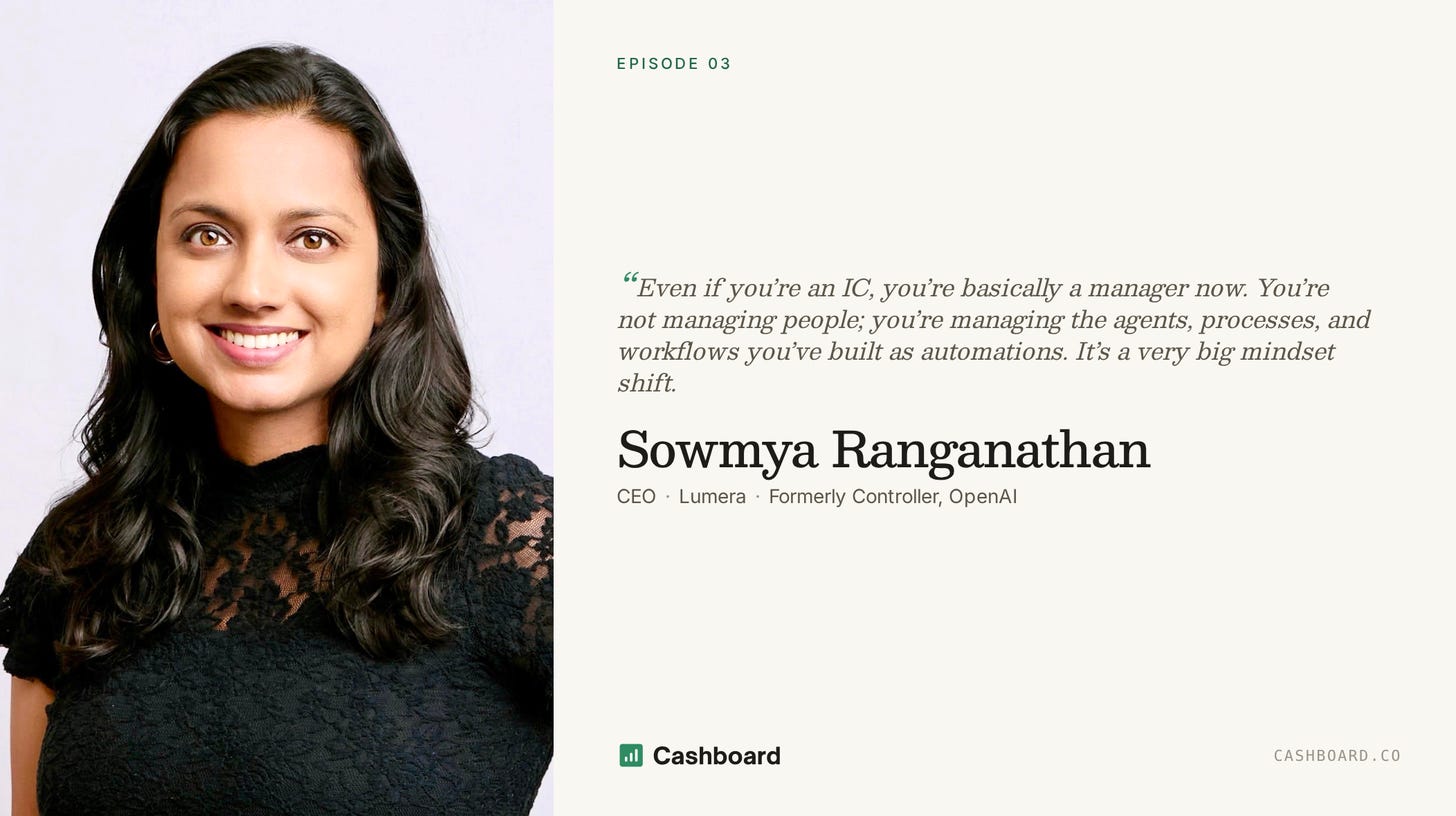
Sowmya Ranganathan is one of the most impressive finance leaders I’ve ever met.
She’s the former controller of OpenAI and Rippling, a CPA, and now she’s building the future of agentic accounting at her own startup Lumera.
I met Sowmya years ago when I was a Rippling customer and we asked our CSM for a demo of their NetSuite connector. And lo and behold: turns out Sowmya was the product manager building that feature, *as well as* their controller, and she ran the demo herself. I’ve been starstruck ever since.
Besides being brilliant and kind, Sowmya’s also the greatest stock picker I’ve ever met – except she’s done it via employee stock options instead of investing cash. Besides joining OpenAI and Rippling early, she also joined Square pre-IPO and helped them go public.
I asked Sowmya about:
Scaling finance at OpenAI after they turned on paid ChatGPT subscriptions
How her team used OpenAI’s products as part of that scaling
The data infrastructure they had to build to keep pace as OpenAI’s ARR went from $28M in 2022 to $20B in 2025 (note: these numbers came from publicly available metrics)
Whether the ‘finance engineer’ is a thing
Building the future of agentic accounting at Lumera
If you only read one thing: my top 5 highlights from my conversation with Sowmya
ChatGPT flattened the SQL learning curve almost overnight. OpenAI’s revenue ran entirely on SQL because the volume was far too big for Excel, and recruiters told Sowmya to pick a lane: SQL people or revenue people, not both. So she hired accountants who knew ASC 606 and let ChatGPT close the SQL gap.
Let the problem pull you to AI, not the other way around. The OpenAI accounting team’s best use cases for AI came from identifying what was “breaking the team,” not from chasing a solution in search of a problem.
Dashboards are easy and you can prompt one in minutes. The foundational work is upstream: capturing the data, capturing all the metadata, and keeping systems in sync. A clean ERP gives you clean reporting and a messy one does the opposite.
Every IC is becoming a manager. Teams get smaller, and roles get broader. The job is shifting from doing the ten steps to building something that does the ten steps, then you handle the exceptions. If you have not considered yourself an architect or product manager in accounting, now is the time.
Governance is what makes finance AI shippable. Anything an auditor has to bless needs access controls, version history, and change management. Without that, finance teams cannot comfortably put the automations they build into production.
Sowmya’s path: EY, Square, Rippling, OpenAI, Lumera
Julian: Thanks for joining us, Sowmya. You’ve had a wild career: EY, Square, controller roles at Rippling and OpenAI, and now founding Lumera. I’d love to hear more about that trajectory.
Sowmya: On the surface, it looks like a mostly traditional accounting path. I started out at EY, went to some tech companies, did accounting, became a controller, and did that again a couple of times. The more interesting thing is that I had a lot of career crisis moments in the middle of that.
At Square, for example, after we went public and did a couple of quarters, I was running close, and I thought, oh my God, is this the rest of my life? Am I just going to be living between quarters forever? I was so close to joining one of those coding bootcamps to change careers and become an engineer. But my husband, who is an engineer, talked me down from that ledge.
Rippling was really fun. I was doing a lot of work with the product teams and sometimes the go-to-market teams because the product we were building and selling was, in large part, for a finance audience. I found that work really interesting, and I thought that whatever I do next has to be something I love as a user, where the job can be more than just back-office close, and where I can actually push the company forward.
After about three and a half years at Rippling, I was ready for a break. The funny thing is that my last day at Rippling was the day ChatGPT came out. So naturally, I became a little obsessed. Most of my AI experiments were about what I could build for accounting use cases, or for myself as an accountant, using this tool. And this is just ChatGPT. This is before coding agents running in the cloud.
When I got an inbound from an OpenAI recruiter, I mostly just wanted to talk to the team and ask what they were doing, because I was so enamored. The finance org at the time was 10 people. I ended up joining the month we started monetizing with ChatGPT Plus, and my first month closing the books was the month we started making real money.
AI on the OpenAI finance team, early on
Julian: How was the OpenAI accounting team using ChatGPT in those early days?
Sowmya: It wasn’t the kind of AI mandate you hear about now. Today, it’s company-wide AI token leaderboards. Back then, no one really knew what it meant to use it for work. Engineers saw the light sooner than most other teams. On finance, we were initially just noodling with technical accounting and policy writing, since it seemed to know so much. It wasn’t really changing how we worked.
The big “aha” for me was that new team members could teach themselves SQL. Our revenue had to run entirely in SQL. These are 20-dollar transactions at huge volume, and there’s no way you’re running that in an Excel file. So I’d go to recruiting and ask them to find me revenue people who know SQL. They, in turn, would ask me to pick a lane: SQL people or revenue people. So we relented and hired an accountant who knows ASC 606. We realized then that ChatGPT could flatten the SQL learning curve. Then, very quickly, we turned it into an internal code-generation tool before people in the industry even had words for these things. We’d just say, here’s the gnarly thing I do in Excel, here are the source files I get, write me a Python script because Excel keeps crashing. It came from a very problem-driven place, and it was successful because you could clearly see the ROI. We didn’t go chasing a solution in search of a problem. Instead, we started by identifying what was breaking the team. Use cases proliferated from there.
How revenue actually flowed at OpenAI
Julian: Let’s talk systems. How did revenue actually flow at OpenAI?
Sowmya: Initially, everything was in Stripe. We had some syncs back to a data warehouse, but we’d write our queries in Stripe Sigma for the revenue data we needed. Then we had workbooks that turned those Stripe queries into NetSuite entries. NetSuite wouldn’t hold transaction-level entries; it would only provide summaries. Over time, we automated that end-to-end. Stripe data would land in the NetSuite Accounting Warehouse, which kept all the raw data. From there, you set up your aggregation, accounting rules, and posting rules in that system. Given how much data was flowing, we pretty much had to stand up an enterprise-scale subledger because of the complexity. With that subledger in place, you can go from a summary entry in your P&L all the way down to the raw transaction. If you want to trace which refund got applied to which payment, you can actually do that.
Julian: This hits home for me. My first CFO job was at Xendit, which is basically Stripe for Indonesia. I joined right after the Series A, and part of why they hired me was because I’d done data systems consulting for hedge funds before business school. Xendit was booking millions of transactions a month, and I had to get the cash balances, the customer liabilities, and COGS all booked to our balance sheet without breaking our accounting systems. I also needed to figure out per-channel gross margins. The scale of the problem needed both a SQL brain and a finance brain. We were basically building our own ledger. It took me ten months to figure out gross margins per channel, banging my head against the wall on the right SQL query and hard-coding things I knew were right today but would be wrong tomorrow. Looking back, I could have ripped through that in Codex in about five seconds. So when you describe a sub-ledger that traces a summary entry all the way to the raw transaction and scales to hundreds of millions a month, I get it.
Sowmya: Exactly. And one of the best things OpenAI had going for it was that the revenue team was already very SQL and data-savvy before ChatGPT happened. There were a couple of people I can think of who were just incredible. If we didn’t magically have those people in the seat, it would have been a disaster from day one.
The rise of the finance engineer
Julian: Funny enough, my own CFO path has an OpenAI connection. When I became Xendit’s CFO in 2018, I’d never been a CFO before, so I asked the founders if they could intro me to other YC-affiliated CFOs so I could learn from them. One of the people they introduced me to was Brad Lightcap, OpenAI’s CFO (now COO), and I remember walking through the Mission with him and asking him lots of questions about NetSuite. In retrospect, I should’ve asked him for a job! Later, through LinkedIn, I watched OpenAI hire a wave of people who sat right at the intersection of FP&A, data, and product and engineering. That’s the “finance engineer” role I keep hearing more about. Is that something you hired for?
Sowmya: Yeah, when the revenue team was three or four people, we started by hiring a finance data person before we ever scaled up the accounting team. This wasn’t quite a data engineer. Think of the role as a hybrid of data engineering, analytics, and a builder mentality, someone who could shadow another person, understand what they were doing, and then automate it. It was an amazing hire for the team. The finance engineer conversation right now is interesting because, in practice, we’ve always had somebody like this: the conduit between systems work, systems thinking, and operational processes. In earlier days, it might have been your Oracle analyst or business systems analyst. Then it became a fintech or business systems team that owned your NetSuite admin and configured customizations.
That role is transforming because the modern crop of systems isn’t so config-heavy. The latest systems are more plug-and-play, and customization now happens at the coding-agent layer: take an existing system and customize it to run my agentic workflow, or use context unique to my business to change how the system takes action. So the finance engineer still thinks the same way, as the conduit between systems thinking and what the team needs. Every few years, there’s a new rebrand. You definitely have more product- and engineering-focused folks now, but honestly, I’ve worked with people in this capacity for more than a decade, and they’ve always had a builder’s mentality. Thinking back to Square, we were on Oracle and had this odd payments recon work. We launched Square Capital and realized that ledger needs to work very differently from how credit card payments worked. We didn’t call it a product, but if you really think about what the team was doing, they were building an internal-facing product for the finance team.
Julian: Role branding matters more than people think. When I got to Xendit, we had a middleware team doing exactly this work, and nobody wanted to touch it. So I took a propaganda-first approach and rebranded it Transaction Intelligence, TXI for short. I basically pretended the old team had been dissolved and this was a shiny new one, even though it was the same people working on the same JIRA tickets. Suddenly, data engineers were excited to join. Branding matters!
Sowmya: Exactly.
What was being built, and what’s still hard
Julian: By the time you left OpenAI, what were people building, and what was still hard?
Sowmya: Toward the end of my time there, we were maximizing and templatizing the work and the prompts. The big shift to coding agents hadn’t fully happened yet, but the coding models have had step-function changes over the last six to eight months. If you talk to the team now, you’ll hear about the proliferation of apps and dashboards people are building on Codex. I can guarantee you Codex is top of mind. Sharing one-off Google Sheets, memos, and packets is fine, but when you can automate that end-to-end and make it a real, living, breathing thing, it changes the work people can do.
That said, the dashboard is almost the easy part. You can prompt and get one relatively quickly. The hard part is how you capture the data upstream, all the metadata, whether it talks to other systems, and how you keep it all in sync. That work really hasn’t gone away. No matter what company, industry, or tech stack you’re in, almost anyone who has done this in real life will tell you: if my ERP data is clean, I can get downstream reporting without a lot of headaches. But if my ERP is messed up, no AI is really going to help me, unless I’m using AI to clean it up… which is a great use case, by the way. A lot of the work we did at OpenAI was the foundational data and process work.
Where finance teams and AI are headed
Julian: Where do you think finance teams will be a year from now?
Sowmya: A year feels like a lifetime and I genuinely don’t know. But the trend I’m ready for as a CPA is that teams are going to be smaller, each role is going to be broader, and you have to think of your role as managing a bunch of work getting done. Even if you’re an IC, you’re basically a manager now. You’re not managing people; you’re managing the agents, processes, and workflows you’ve built as automations. It’s a very big mindset shift.
Previously, you could have a job where you knew the ten steps you needed to do to get something done, and that was the job. The future of the job is about making something else do those ten steps, and you’re only looking at exceptions or changing the process when it needs to change. So if you haven’t thought of yourself as an architect or a product manager in accounting before, now is the time. I think everybody is moving to that world.
Julian: And that’s the world Lumera is built for. I’d love to hear more about what you’re building.
Sowmya: What we do at Lumera is give teams a way to do this collaboratively and in a controlled manner. Instead of everybody spinning up their own cloud coding environments, with a bunch of skills that aren’t transferable across projects and no real access controls or change management, the platform handles a lot of the boring governance: the audit-ready stuff somebody needs to do so finance teams can comfortably communicate how they’re changing the code and how they’re building.
We’re tech-stack agnostic, so we connect to whatever tools you have, from ERP systems to G Suite to your payroll and AP systems. You bring whatever data you need, you pick your coding model, and you just start telling the AI what you want built. The difference from other site builders is that the coding agent doesn’t just build the site or the dashboard. It builds your full backend infrastructure. It can spin up agents and sub-agents, multiple of them, and do all of it in the background, so you, the user, can just focus on what you’re building and what your end outcome is.
Those outcomes can be inputs to your financials, like automating your close work, and not just the checklist, but every item in the checklist that used to be something you did manually. Then you automate downstream, like reconciling Salesforce and NetSuite, and keeping it in sync forever. The main thread I see is that anything an auditor needs to bless is happy living in a platform like Lumera, because it’s backed by the governance and controls you need. Every project has its own permissions. You give people viewer or editor access; you get version control and deployment history; you can figure out who did what and restore to an old version; and all changes to permissions are logged automatically for you.
Julian: So Lumera helps accounting teams get IPO-ready with a tenth of the staff, much faster, with all the controls in place?
Sowmya: That’s the idea.
About Sowmya & Julian
Sowmya Ranganathan is the founder of Lumera and the former controller of both OpenAI and Rippling. You’ll find her on LinkedIn and at lumerahq.com.
Julian Rowlands is the founder and CEO of Cashboard, the AI enablement platform for FP&A. He was previously CFO of Xendit (last valued at $3bn) and Head of Finance at Spruce (exited to Zillow in 2023). You can learn more about Cashboard at www.cashboard.co.
Interviews with CFOs about AI is an interview series by Cashboard. We speak with finance leaders who use AI in their day-to-day work, and ask them really detailed questions about their setup.
If you’re a finance leader building with AI, we’d love to interview you! Email julian.rowlands@cashboard.co with a quick summary of what you’ve used AI to accomplish, and we’ll get a call booked.